


Solar panels on the roof and an EV in the driveway are a natural match. The sun produces power during the day, the car is often parked at home during the day, and every kWh you put into the car is a kWh you do not sell back to the grid at a low rate.
A Peblar charger measures what your panels produce and what your home uses, and charges on the difference. How it does that is up to you. This article explains the four solar modes: pure, smart, fast and custom.
Solar charging works by default
Before choosing a mode, it helps to know that any charger uses solar power to some degree. Your panels feed power into the fuse box, and the charger draws power from the same fuse box. When your panels produce more than your home needs, that surplus flows to the charger first, and only then does the charger ask the grid for more.
The difference with a Peblar charger is that it can see how much surplus there is, and adjust the charging current to match. That is what solar charging means in this article: the charger actively follows your solar production instead of simply drawing full power.
To do this, the charger needs a measurement of your household power. This comes from a compatible energy meter, a HomeWizard P1 meter, or a supported inverter. The charger reads the value at the grid connection, so it knows at every moment whether you are importing from the grid or exporting to it.
One number to remember: 6 A
An EV cannot charge at any current you like. The charging standard sets a minimum of 6 A per phase, which is about 1.4 kW on a single phase. Below that, the car does not charge at all.
This minimum is the reason the three solar modes exist. On a cloudy morning your panels might produce 800 W of surplus. That is real energy, but it is not enough to reach 6 A. Each mode handles that situation differently.
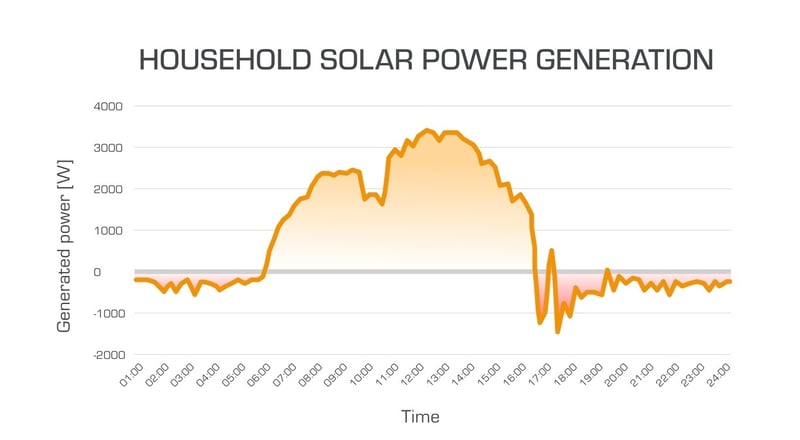
Solar pattern: Negative is when household is using more than what is generated. So between 6:15-16:45 there is a surplus.
Pure solar
Pure solar charges on surplus only. The charger waits until the surplus that would otherwise go to the grid is enough to charge at 6 A. It then starts charging and follows your solar production up and down. When the surplus drops below the minimum, charging pauses until the sun returns.
Not a single watt comes from the grid. This makes pure solar the best choice if you want the lowest possible charging cost and you are not in a hurry. The trade-off is that on a grey day, or with a small solar installation, the car may not charge at all.
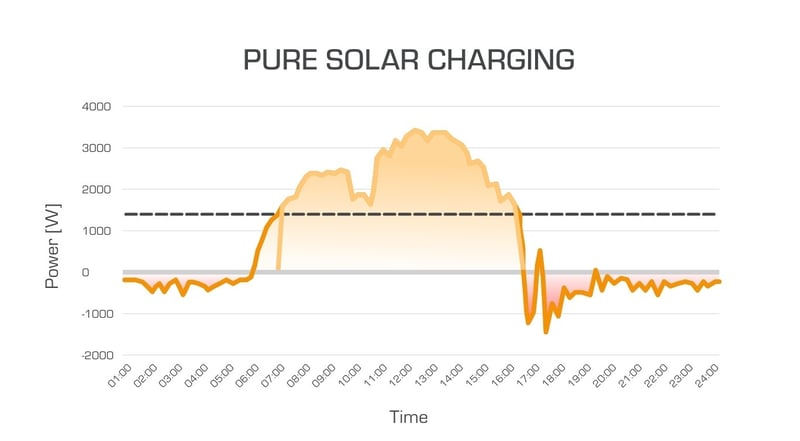 Pure solar: start charging with the surplus power when this surplus is higher than the minimum threshold (threshold = dashed grey line, EV behaviour = light orange line).
Smart solar
Smart solar uses all of your surplus, and adds a fixed 920 W (about 4 A) from the grid on top. Because the grid share is always there, charging starts at a smaller surplus than pure solar needs, and it keeps going when a cloud passes. As the surplus grows during the day, the charging current grows with it.
Smart solar keeps the car charging even on a mixed day. You still use every kWh your roof produces, and you accept a small, constant share of grid power to keep a steady flow.
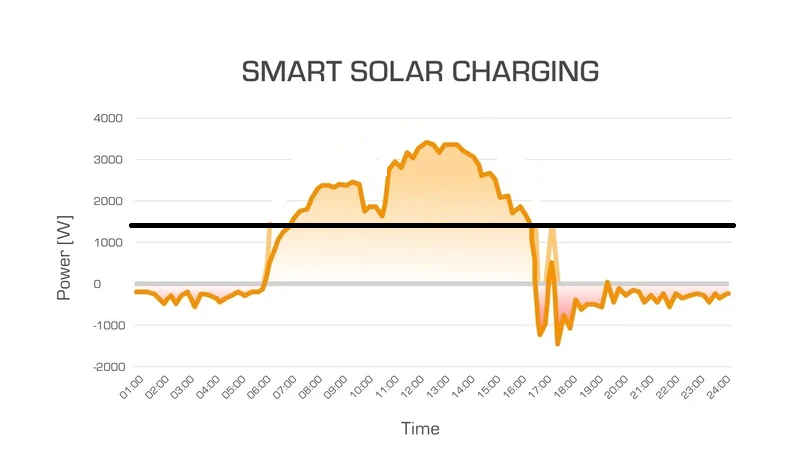
Smart solar: start charging at a lower threshold, follow pattern + add power from grid
Fast solar
Fast solar starts under the same condition as smart solar, but once it starts, it charges at the maximum current available. All surplus solar goes into the car, topped up with grid power to reach full speed.
This is the mode for when the car has to be ready soon. You use the sun where you can, but charging speed comes first.
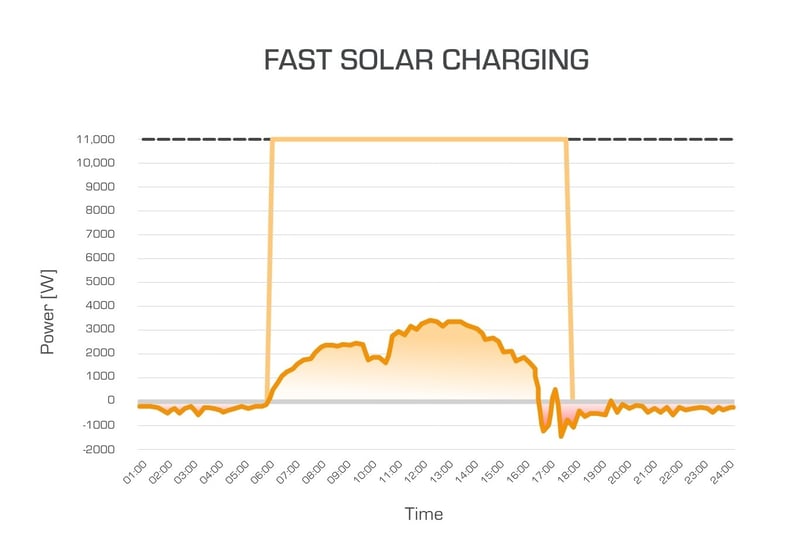
Fast solar: start charging at a lower threshold, charge with maximum available current.
[Max available charging power = dashed grey line]
Custom solar
Pure, smart and fast cover most homes. But every house is different. Some have a heat pump running all day, some have a battery, some have a very large roof. For those situations there is a fourth option: custom solar.
Custom solar gives you three settings in the Peblar web interface, under solar charging. When you open it, the values you see are the ones pure solar uses. That gives you a known starting point: change one value at a time and see what it does for your home.
Start/stop power threshold
This is the amount of surplus power at which the charger starts charging, and below which it stops again. Pure solar uses a fixed value. With custom solar you set your own, in watts.
The value is written the way your meter reads it: exporting to the grid is negative, importing is positive. A threshold of -1300 W means the charger starts once you are exporting 1300 W or more. A lower number, for example -800 W, starts charging earlier in the day and stops later in the evening, at the cost of using a little grid power to reach 6 A.
You can also set a positive threshold. This is useful when a heavy appliance runs during the day. Say your panels produce 2000 W and your home constantly uses 3000 W. You are importing 1000 W, so you would never reach a solar surplus. With a threshold of +1000 W, the charger starts as soon as your household usage drops under 3000 W, so the car charges while the rest of the house is quiet.
Grid power target
Once charging has started, the charger adjusts its current to hold a target value at your grid connection. Again in watts, and again with the same sign as your meter.
A target of 0 W means the charger tries to use exactly your surplus, so you neither import nor export. A negative target, for example -500 W, keeps 500 W flowing to the grid, which leaves room for a home battery or for a feed-in contract you want to keep using. A positive target lets the charger draw that amount from the grid on top of the surplus, for faster charging.
Always charge
Tick this box and the charger does not wait for the threshold. It starts charging the moment you plug in and follows your grid power target from the first second, at a minimum of 6 A. This gives you a quick start, without giving up on solar for the rest of the session.
Two things to know
Once charging is active, the charger always supplies at least 6 A. The threshold decides when charging starts and stops. The grid power target decides how much current the charger asks for while it runs.
The threshold is measured before the charger starts, so the charger's own charging power does not count towards it. The two settings work independently, so you can for example start at -1300 W and then hold a target of 0 W.
How this looks in practice
Picture a typical day. Your panels start producing at 06:00, peak at around 2200 W at midday and stop at 19:00. With a threshold of -1300 W and a target of 0 W, the charger starts at about 09:30, charges on the surplus through the middle of the day, and stops at about 15:30. Everything between those times goes into the car, and everything outside them goes to the grid as before.
Lower the threshold and the charging window widens. Raise the grid power target and the charger draws more, so the car is full sooner. Tick always charge and the session starts the moment you plug in. Custom solar lets you choose where you want to sit between the cheapest charge and the fastest one.
What solar charging does for the grid
More solar panels are being installed every year. On sunny afternoons, this pushes a lot of power into local grids at the same time. The result can be high local voltages, which can damage equipment or cause inverters to switch off automatically, which wastes solar energy.
Charging your EV on your own surplus helps here. Every kWh that goes into the car is a kWh that does not have to travel through the local grid. Solar charging is good for your energy bill, and it makes the grid around you more stable.
Frequently asked questions
Do I need extra hardware for solar charging?
Yes. The charger needs a live reading of your household power. This comes from a compatible energy meter installed by your installer, a HomeWizard P1 meter, or a supported solar inverter.
Which mode should I pick?
Pure solar if cost matters most and time does not. Smart solar for a steady charge on mixed days. Fast solar when the car needs to be ready. Custom solar if you want to tune the behaviour to your own home.
Where do I change the solar mode?
In the Peblar web interface, under solar charging. Make sure your charger runs the latest firmware. Updates are installed remotely, so there is nothing to do on the charger itself.
Does solar charging work on three phases?
Yes. On a three-phase installation the minimum is 6 A per phase, so the charger needs a larger surplus before it starts. Your installer can set the charger to switch to single phase for solar charging, so charging starts earlier.
Why is my threshold a negative number?
Because it follows the sign your meter uses. Exporting to the grid is negative, importing from the grid is positive. A threshold of -1300 W means charging starts once you export 1300 W.
Charge on your own sunshine
Solar charging is built into every Peblar Home and Peblar Business. Pick a mode, plug in, and let the sun do the work.
